Monthly Archives: March 2011

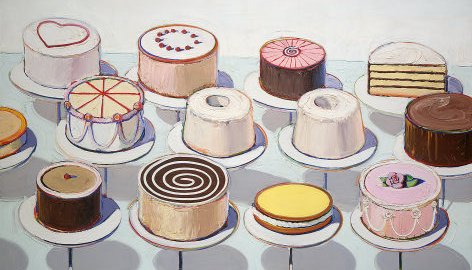
Cakes 1963 - Wayne Thiebaud

Why Pie?

I have a test question for you. If I spent my Sunday trying to perfect Boston cream pie whose paintings did I enjoy on Saturday?

It was a rainy Saturday so my daughter and I went back to the Crocker Art Museum. The art we soaked up got me thinking and, questioning again. I have asked here “Is THAT art?“, “What IS art?” and “Is graffiti ART?“. Now I am led to ask why did the artist choose that subject; why THAT art?

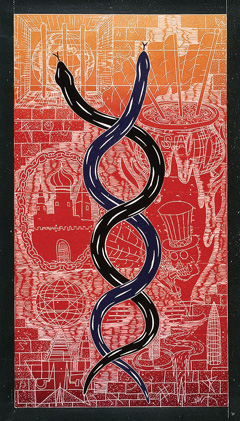
We saw a broad range of art at the Crocker. First we spent an hour looking at an exhibit by John Buck entitled Iconography. Every strikingly beautiful print was as striking in its capacity to generate thought. They were very large format wood block prints carved with bold designs and filled from top to bottom with intricate details. It was those details that got the discussion flowing. One print was of a bottle filled with carvings depicting the effect of the arrival of the white man on the Native Americans - the deadly cost of our disease and alcohol. Another depicted the environmental price of deforestation and oil drilling.
It was obvious why he chose these topics - they are meaningful, important and compelling. Another exhibit we saw was less so. It was simply confusing to me why Daniel Douke’s work in the exhibit Bytes of Reality was there. He showed great technical skill in his ultra-realistic paintings of mailing boxes. They seemed to be a cross between Duchamp’s found objects and Warhol’s Brillo boxes. The Crocker’s website states:

By making these discarded boxes art, he gives them permanence and value, challenging our assumptions about reality and artifice.

At the risk of sounding uneducated, I don’t get it. A docent tried to explain the work to me but left me wondering if I was looking at the emperor’s new clothes and feeling that some one was telling me a story already told well enough before. Besides this judgment, my biggest question was this: “WHY mailing boxes”?

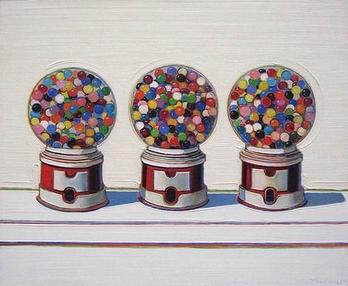
Next we entered the permanent collection which includes the works of many California artists. Positioned to the forefront; in the first room is a group of paintings by Wayne Thiebaud. Thiebaud paints with thick brush stokes of vibrant colors; bright white, edges of purple and orange. He depicts scenes of San Francisco’s rollercoaster streets and some central valley landscapes but is most known for desserts. Not deserts, no. Cakes, gumballs, pastries and pie. Boston cream pie to be exact. I love pie and really enjoy his work. It makes me hungry. But that day mixed with my hunger, was that same thought. Why does Thiebaud paint dessert?

Two great artists. One etching monumental works of powerful concept. One painting with mouth-watering precision, pie. Why the pie?

“If the world were a perfect place,” wrote Michael Kimmelman in the New York Times in 2001, “the Wayne Thiebaud retrospective that has just opened at the Whitney Museum would be nailed to the walls for good and we would be free to stop by whenever we needed to remind ourselves what happiness feels like.”

So indeed, some art may just be meant to make us happy.

Now, does anyone have a better recipe for me?
Water to Wine

After spending an afternoon writing a brief article for work about how to discuss and prevent alcohol use in preteens I brought the topic up at dinner. The responses from the two preteens present were gratifying (whew!). I asked them why they think some kids try alcohol. The 11 y/o said simply “stupid peer pressure”. The 9 y/o said simply and emphatically “ew!”. The 14 y/o was not there but, the discussion reminded me of a similar chat we had with him years ago.

We were sitting around the dinner table with another couple and their child. The two boys were probably about 7. Somehow the topic of drinking alcohol came up and my son asked why grownups were allowed to drink but kids weren’t. This is a good question that your preteen may ask you if you open this topic up at the table tonight. The societal messages around drinking can be confusing for kids. We tell them they can’t drink until 21. However, many people seem to think that alcohol use in teens is better than drug use (this despite the scary statistics to the contrary). TV shows, movies and video games can make it look like everyone drinks. That night we explained to the kids that one reason kids are not allowed to drink is that young bodies do not metabolize alcohol the same way as adults. That it is much more dangerous for a young child. The next morning, my son used this information to point out another mixed message in his world.

It was Sunday and although not always faithful church-goers, we went that morning. Early on in the service there was “discovery time” when the young children come forward for a brief lesson directed at their level from the minister. That morning it happened to be a talk about turning water to wine. The kids were captivated and fascinated when the minister poured plain water ceremoniously into a pitcher (with some powdered purple drink mix hidden on the bottom) and then poured out the “wine” into cups to share with the kids. My child gasped and gave me a mortified look from the front of the church. He then proceeded to run down the aisle, jump into my lap and rather loudly exclaim “He’s trying to kill me Mom”!

Indeed, society promotes alcohol to our children and they find many mixed messages around them but, ministers are usually not in the business of scaring small boys! Your preteen though, is still at an age where he believes in you and your abilities to teach him are miraculous; start talking tonight!

Spring Has a New Name

Sure, every mom does lots of laundry. I too do lots of laundry. It used to really bug me. I would try different systems of managing the endlessness of it. My sister-in-law swears by an only one day a week system. No laundry for 6 days did sound like a dream come true….problem was that the seventh day was hell.

It is the folding that really kills me. I don’t seem to be able to stay on top of it. My best friend suggested her trick: don’t. She hucks the load of clean laundry on her bed and the kids sort through and grab their own stuff and…stuff that in their drawers. My mother was horrified when I tried this; she straightened their drawers and folded every thing in the house for the whole week she visited.

I came to peace with the laundry some time ago. I decided to try a zen-thing with it. Tried to focus on the moment, to feel the cloth as I folded. Enjoyed the peace of the laundry room alone. Started listening to NPR podcasts to get me through. I developed a nifty system of organization in my laundry room. It was, as they say, all good. For a while. Then, spring hit.

Spring came last year and involved one baseball player, one softball player, one lacrosse player, two swimmers, five skiers and a new puppy. Wet towels, muddy pants and smelly socks piling up day after day threatened to take me down the path to insanity. How is a mom supposed to keep up with spring in the laundry room? Well, I think I found an answer. Make that three answers, a boy, a girl and their brother.

Spring has come again. I call it Laundry Season. This time it involves three lacrosse players, two swimmers, the ?dog and five skiers. Yesterday one of them came to me and asked what setting was right for his lacrosse pads. Cool.

Oof!

I am still reading The Creative Habit by Twila Tharp, I am motivated by Doctor_V but, I still haven’t gotten out of bed before the sun to write. What a struggle this creating a writing habit is. I write for fun, I write for pay, I write to get better at writing but, increasingly it is hard to carve the time to get the job done.

The kids interrupt. The “dog” barks. The cell phone rings. The house phone rings. I ought to exercise. My hair grew. The garden grew. My neighbor is all kinds of fun. All kinds of excuses. But dear reader, the biggest distraction is this computer! Email (on 4 different accounts, don’t ask), Facebook, Twitter. The NYTimes and LATimes on-line. Love Wikipedia! Need to check to see if I have comments here to respond to. How many people looked at my blog today?… Oof! How, when we write for a living on the computer, do we turn it off to write?

©

The “Dog”. What is your theory?

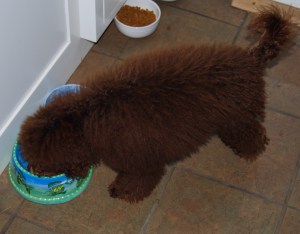
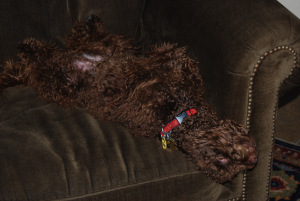
Late one night in January last year the kids came running in the front door thrilled with a fuzzy new find. Percy was an abandoned, dirty, matted and very hungry 2 month old puppy of indeterminate breed. We tried all the usual channels but, no one ever claimed him. Puppies, it turns out, are a bit of work. We (read that as: the grownups in the house) were thrown into a cycle of late night runs for the backyard and endless rainy walks saying (on the advice of a well-respected puppy trainer) “Do it, Percy, Do it” to train him to defecate on command. As if. I started searching for recipes that would separate the meat from all that hair. No luck. It has since then been pointed out to me that I did not actually have to keep the critter that perhaps, I should have told my three beaming children “No”. Right. You try.

Everyone likes to give us their theories about what exactly, he is. Portuguese water dog? Something-a-doodle? Bijon frise? The cat thinks he is a cat. He thinks he is …comfortable here.


©

Hungry Caterpillars and Hungry Minds

The AAP decided recently to use the book The Very Hungry Caterpillar as a tool to promote healthy eating. Great idea! In fact so great it brings me back 7 years ago to a presentation I gave to my daughter’s preschool class. I used the food pyramid and The Very Hungry Caterpillar to explain healthy eating to that group of 3, 4 and 5 year olds.

You know the story right? That little guy starts off well, growing up eating lots of fruit. Then he branches out to the junk. Sausages, lollipops, cake, pie. Not surprisingly he gets a stomach ache which is only cured by a return to his prior plant-based diet. Since that preschool presentation I have time and again explained this story to my patients and given them the book (courtesy of fabulous Reach Out and Read).

When I heard about the AAP’s promotion I tweeted about it “This is great! I have used same book to teach nutrition for years!”. A fellow tweeter was surprised. His response (in 140 characters or less):

I can see the connection, but I would not have made it myself. Are the kids really open to understanding nutrition that young age?

Ah, yes. They are. Here is a little understood fact (one my mother understood well): talk to children just as you would any other human and they rise to the occasion. If they don’t understand they will ask you. If you teach down to them they will tune you out and you will lose their respect.

This point came up again this week while I was in the locker room after a swim. We swimmers solve all the worlds problems in the locker room. I ask the vet about my “dog”. Folks ask me about their kids. The discussion Tuesday was how and when to have “The Talk”. My answer was simple: don’t. I suggested instead, that making sex ed a natural part of their upbringing week in and week out was far more effective. Don’t wait for a big talk at a time when you think they are ready or old enough. Have books to read together. Have books for them to look at alone. Talk early and, talk often. And that brings me back to the caterpillar: answer their questions as they ask them without worry for what material they are old enough to understand. Kids are curious sponges; ready to soak up whatever knowledge you are ready to offer them be about sex or caterpillars.

©

Pink and Purple Circles

Promoting arts education is crucially important for our kids. Before I leave the background discussion of why I need to address one last point. Arts education is often taken to mean creating and performing art. Art history is also of value. This involves art criticism, the academic study of art with its stylistic and aesthetic context. It gives us the ability to understand the sublime that is art.

Briefly, three ideas for why the contextual study of art should be included in the standard arts education:

  • Understanding what influences the framework that art hangs on allows a more enjoyable connection with it. This is likely better explained with an example. My kids all went to a wonderful parent cooperative preschool. On my workdays there I loved being at the art table. Over the years I became increasingly impressed with the influence the children had on each other’s artistic styles. There might be three kids at the table painting away. One more would join in and start painting say, concentric pink and purple circles. Soon I would notice lots of use of pink and purple and lots of circles appearing across the table. Over time I worked with the teachers to form a yearly art exhibit where we hung the kids art on the fences in the school yard. It was grouped by period and context. It was a joy to see how the kids had developed together! This ripple effect or evolution of style is seen in our study of major schools of art. Artists influence each other and create an ongoing evolution of artistic style.
  • An understanding of the evolution of tastes in art generates acceptance of diversity. Artists through time have often been scorned when they challenged commonly accepted ideals with new approaches. They take a new approach that eventually becomes the accepted norm (think pink and purple circles). Seeing this progression as it has played out repeatedly through time can teach kids an acceptance of new thinking, new looks, innovative approaches. It can help them be less judgmental of differences in those around them.
  • Understanding the mechanics of creating art is valuable. Artists work hard. Really hard. They practice day in and day out in order to produce what can often appear simple. Have you ever looked at a modern painting and thought “I could do that”? Likely, you could not. Professional artwork requires both innate talent and earned skill. Understanding this can encourage and motivate a child in their own persistent efforts.

Art is more sublime when hung on a framework of understanding. You have more fun when you can see where the story behind the pink and purple circles. Then you might be motivated to go home and try some of your own.

©

Black and White in Art and Life

I am having a bit of a free association sort of rainy Sunday. Funny about our minds isn’t it? The way we can unconsciously shift through the bits and pieces of what we read or hear during the week to come up with a theme of sorts. What follows is the intersection of learning about the great dance choreographer Twyla Tharp, the painter Caravaggio and thinking about a few failed interactions I have had with patients through the years.

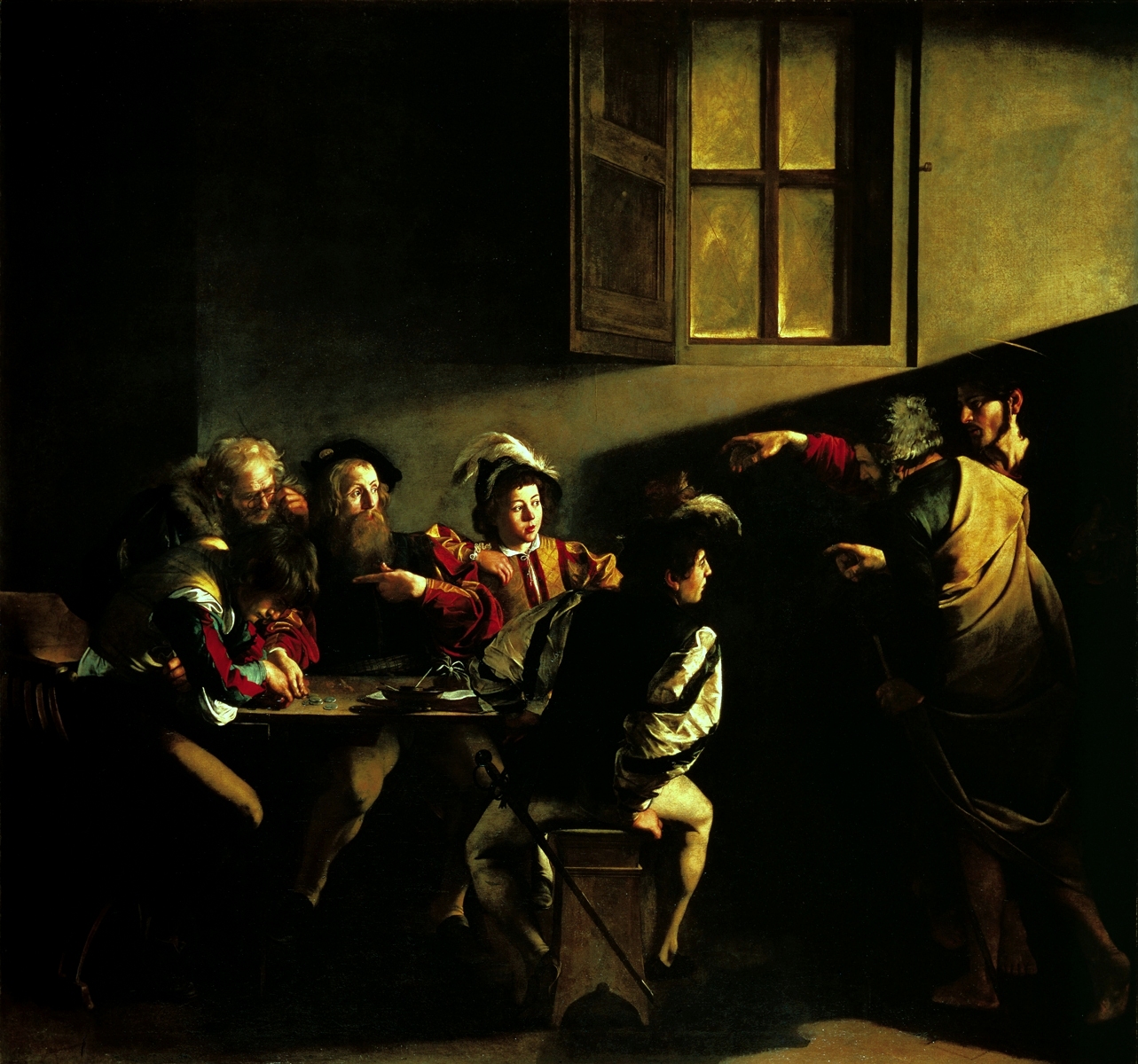
The Calling of Saint Matthew (1599-1600) by Caravaggio

Twyla Tharp explains in her book “The Creative Habit” that she prefers to divide people in her world into two distinct categories: acceptable or not, good or evil, “committed or missing in action”. While I find the book well-written and find myself inspired by her advice, I was bothered by these comments. I recognize that for her this commitment to embracing the extremes rather than the grey zones is artistically motivational but for me, it grates against my own approach to people. I prefer to work in a grey zone embracing the nuances of the personalities I find around me.

Michelangelo Merisi da Caravaggio was an Italian Baroque painter in the late 16th century. He is known for dramatic, dark, richly and realistically depicted paintings of an often religious theme. He is also known for having been a murderer. Good (artist), evil (killer) and yet, to view him fully as one of these extremes we would miss the other side to his story and miss the influence these complex components of his persona have on each other. We would make an error of judgment.

As doctors, we give our best care and make our best diagnoses when our minds are open. I remember a professor in medical school telling me to begin my care for every patient by imagining that the patient’s illness was a tree that I stood at the foot of. A tree full of possibilities. As I tried to figure out their diagnosis I was to consider climbing along a branch chosen after a pruning of other possibilities by listening to their history. The physical exam would allow a deeper cut of the choices, lab tests, xrays and time allowing me if fortunate, to end up on the right twig with the right diagnosis.

I read a blog post today about errors made when “hysterical” E.R. patients’ complaints are dismissed. Someone loudly and dramatically requesting that they want a certain pain medication in a busy E.R. does tend to get ignored or, written off by the doctors and nurses who care for them. These patients are judged rather than treated in the grey zone of acceptance and this judging can lead to medical errors. This brought me back to two times in the past when such bias crept into my patient care. In both cases I was “warned” before entering the exam room that the patient or parent was difficult in some way causing me to walk into the room seeing a tree with already pruned branches. And indeed, I ended up on the wrong twig at the end of the visit.

Twyla Tharp is a supremely talented artist whose approach to slotting people into good or bad fails me both creatively and humanistically. Caravaggio was a troubled man with a gift; art influenced by his turmoil or, a man of grey shades. Patient care is best done with a clear eye towards the complexity of human nature.

©

Connections and Bonus Questions

I just read “18 Stethoscopes, 1 Heart Murmur and Many Missed Connections” a fabulously written article in the New York Times by Madeline Drexler. She tells her story of being a model patient - a person with a medically interesting “finding” who is asked to help teach medical students. These “patients” are examined by small hoards of inexperienced medical students who have little knowledge, little skill and varying degrees of innate bedside manner.

I was fortunate enough to go to a medical school where we began examining patients - real and staged ones - from month one. I still remember many of these people well; more clearly perhaps, than those I cared for in my sleep-deprived haze of residency. As Ms Drexler describes, I am certain that back then, I too was filled with awkwardness and overtaken by my interest in the examination findings at the cost of expressing empathy.

There is one that comes to mind now. He was a model patient for my final exam in a class on physical examination. I think he might have been the bonus “question”. I had studied hard. I was tired. He was in a room behind a door I nervously opened to find the answer to what exactly was different (medically speaking) about him. There in the room, on an exam table sat this young man. He may have been 25 or so. Dark haired, bespectacled and calm. I approached him and began the work of examining his body for a “finding” of sorts. Heart, lungs, abdomen… all depressingly normal. Mouth, neck, ears…getting closer. Then to my joy I found “it” and remember well the thrill when I did. There was a big part of me that wanted to say ” Woo Hoo! I did it”! Ms. Drexler describes this reaction in other students:

“This was a student who is not uncaring or unkind,” Dr. Treadway told the class. “But in that moment she did something all of us do all the time: she was so engaged with the problem that she forgot about the person who had the problem.”

I had a favorite attending doctor in medical school. Everyone else was scared of him. I looked up to him. Sure, he asked the hardest questions and embarrassed me at times. I stood tall with the knowledge he was doing this to make me better. And, when I watched him with patients and parents I saw that all of his sternness evaporated; he became the most caring doctor in the hospital. He asked, as Ms. Drexler reminded us to do, about how it felt to be stuck there as patient or parent. When he was talking with a family it seemed that perhaps, time had stood still. He had no where else to go, nothing else that mattered more than the people in front of him.

I think of this man often. He motivates me still. And, what I know now after all these years, is that I am still learning. Every visit with every patient I strive to become better at listening, interacting, understanding. I reach for the ability to make them feel that time has stood still in that room with them. I am not there yet but - reading Ms Drexler’s words and remembering my attending’s gifts help me feel that I might, just might get there some day.

P.s.: The answer to the bonus question was prosthetic eye.

©

“You have to be a bit outside of something to see it.”

Since reading the New York Times this Sunday I have been thinking about Glenn Ligon’s quote:

You have to be a bit outside of something to see it

These words have been rolling around a bit in my head. He was describing another artist’s work and these words had a specific meaning. However - like many quotes taken out of perspective we make them our own; we give them our own new meaning. For me they brought to mind the truth that can appear when we have the opportunity to view not only art, but people a step apart from them. There can be such breathtaking beauty found in seeing someone we care about unexpectedly before we realize they are our own.

We are usually so embroiled in the daily work of parenting that we do not often have a chance to see our children (our greatest works of art) from a view a bit outside of the experience of parenting them. A few years back I wrote a brief article about nurturing friendships in young children. Part of the advice I offered was about how to handle the end of a playdate:

When it is over and you deliver the friend to their parent take time to praise their behavior to the parent – this makes both child and parent feel good and ultimately helps strengthen the budding friendship.

Taking time to reflect positively on another child to their parent can share with them one of those magical moments of seeing their child outside their usual perspective - it indeed makes all involved feel great! This advice and Glenn Ligon’s words also came back to me in the office recently. I was seeing an emotionally challenged child and her parents. Somewhere near the end of our visit I commented on what a beautiful person she was and how her strength of character combined with her parent’s incredible support would help her rise above her struggles. As I mentioned her shining nature I saw a glimmer of relief in her mother’s eyes. For a second her haze of stress and worry parted and she could see her daughter there across the room as I did - a beautiful person with a positive future.

These times of seeing our children a bit outside of our usual view are gifts to be savored and shared. Enjoy!

©