Monthly Archives: July 2011

IMG_1260-Stars-2

A Twinkling Metaphor for the Path Towards Health 2.0

In my ongoing stream of consciousness about art and medicine a new connection has worked its way to the surface. Medicine it seems, is in a state of flux, a state of change and evolution. The hubbub about this is alive in Twitter feeds and on many physicians’ blog sites. The dialog has been centered on the role of media in healthcare, of the use of the internet in patient care, the grooming of new medical students to be our future leaders. The path forward towards the grand new world of health 2.0 is a shifting one with moments of clarity and moments requiring innovation and faith all discussed hotly in the world of social media.

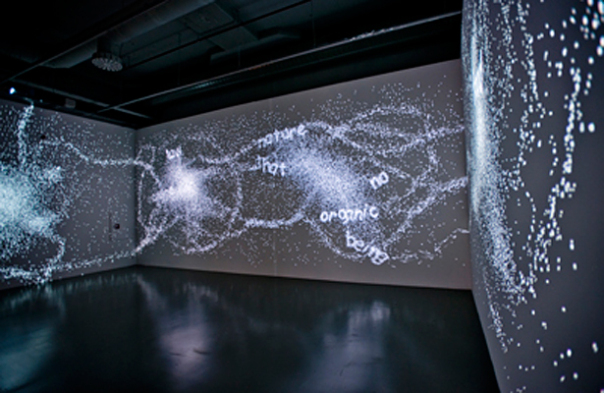
This flux is nicely brought to life in a work of art I recently enjoyed. The artist Charles Sandison produces digital installations of grand physical and philosophical scale. Moving, flowing, changing and in the case of his “Origin of Species”, evolving. This piece is made of points of light swirling around the walls and corners of a darkened room. The lights coalesce at times, into words and form - two words at a time - the entire text of Darwin’s manuscript on evolution. As words meet each other they form the next words in an unscripted display that will take two years to be completed.

when the word man meets the word woman, the word child is produced; and when man or woman bumps into the word threat, the word dead replaces them ~ Ken Johnson

This seems a fine metaphor for our collective musings on the path forward for medicine. The lights in our heads form words that meet in the blogosphere to merge and change into the next iteration of ideas. This forward progress may take some time but - won’t it be great to watch? I would love to see what Sandison would come up with to display our collective efforts as we evolve.

Perhaps on the wall of lights that describe healthcare 2.0 in words two by two we would see that:

“social” and “media” will merge into “expected”

“empowered” and “patient” will merge into “reality”

“work” and “balance” will merge into “obvious”

©

Carl Andre - 9x54 Napoli Rectangle - Alfonso Artiaco, Napoli-Sep

On Turned Exam Tables

I was asked recently by work to write an article for a newsletter about physicians’ experiences with illness. My response to this request was to say that I have been trying to write this very article for a few months and through my efforts I have experienced a new “illness”. It is apparently, quite a powerful one and has had me in its grip for some months now. Its name is writer’s block.

Tonight though, relief has come - in the nick of time. I was reading a NY Times article about a minimalist sculptor Carl Andre. It was entitled “Less is Less” which set me thinking. I started a blog site to challenge myself to improve my writing, to practice writing and to observe myself in the role of writer. One observation to date has been about how story ideas come to me - usually by an odd trickling of input from multiple sources coalescing together to form a lit-light bulb moment of “Aha!” and then, out it flows. No different today. After weeks of struggling with what message to write about from my way too many experiences on the other side of the examination table, that title “Less is Less” did it.

Less is less? Huh? What? I thought less was more. Exactly! That’s it! Every time I began to write about my experiences with being on the other side of the exam table over the last few years, I had too much to tell. I, doctor come patient, tried telling all the stories and giving all the advice I could. But that was too daunting. Instead I find myself thinking, when telling a story, sometimes less is more and, in the world of forming a bond with your patients? Less is definitely less.

Five years ago, I ruptured my appendix while on vacation in Hawaii. When I made it back to the mainland I faced surgery and a week-long hospital stay. Being the patient it turns out, really is hell. And the worst? The worst was that easily 75% of the people involved in my care did not introduce themselves, leaving me to feel lonely and objectified. From the phlebotomists and radiology technicians who worked without verbal identification, to some nurse and doctors. Yes, doctors. After the initial ED doctor took his history, the nurse gave me some blessed pain relief and the CT was done I waited. And, waited. Then, suddenly into my room burst a young resident who abruptly leaned his forearms on my the rails of my gurney (ouch) and said “So! You have an appy!”. I was tired and in pain so forgive me when I tell you that I looked at him and said in my best attending voice, “I am Dr. Land. And, who the heck are you?”.

This spring I managed to tear all of the hamstring tendons off my pelvis. The repair for that gave me the chance for another stay in the hospital. What a difference five years have made in the quality of care! Every single person introduced themselves and explained why they were with me. They spoke in terms anyone would understand. From the nurses and technicians to the people cleaning my room and the doctors. Yes, the doctors.

This is where more was so clearly more. At my first meeting with my surgeon he entered the room with hand held out, eyes on mine and a calm smile. He sat. He began by asking about me, about my family, about my job. He cared! He went through my chart in careful detail - family history, medical history, medication list cleanup…. all for my hamstring tendons. I was left feeling that if he cared to take the time to hear about my children and my job, if he cared that my mother and father both had lymphoma, that I no longer take Prilosec then - Wow! He must care about me and he must be a very detailed and thorough surgeon. At my first post-op appointment he asked first how I felt. How was I handling the long weeks of braces and crutches and being non-weight bearing? Then he asked how my daughter was recovering from her appendectomy (that last bit falls under the category of “when it rains it pours”). Only then after these kind moments, did he dive into what he was there to accomplish.

I learned much from these two times on the patient side of the exam table. Overtly stated, when we as physicians begin properly the rest falls into place. Start with a slow, calm, eye-held introduction. Get to know the person you are with. Then, proceed forward in your work as their doctor. From this beginning success will follow.

haring-keith-logo-against-family-violence-with-baby-heart-1989

Understanding the Family: the power of a careful social history

Perhaps it is my week to be inspired by others blog posts. In the post Do You Like Your Pediatrician? Yolanda MD comments on the importance of forming an emotional connection with patients. After the first visit to her baby’s pediatrician she felt ambivalent about the experience because the doctor did not:

ask any personal questions to get a sense of who we were as a family. … I would expect that knowing the social context of a new patient is an important step to building rapport.

Recently a colleague of mine retired. When I joined the practice 11 years ago he took me under his wing. We are both athletes at heart and love to see patients who are athletic themselves. Sports injuries were fun for both of us; he taught me lots about broken bones, sprains and tears. He was emotionally wise as well. It was him I turned to fess up to a third not-so-well timed pregnancy. I had just been hired and was fearful of being let go after a trial period so I hid in a too-large white lab coat until I was 20 weeks along. Then one afternoon I screwed up my courage and sat in his office.

I, um, have something to tell you….

Now I can still remember my sense of peace and confidence when he simply smiled and warmly said his congratulations.

When he was close to leaving our office this winter I battled my own sense of loss by asking two things of him. I asked to have him refer those patient-athletes to my practice and I asked for some of that emotional wisdom. Specifically I asked him for his advice for bonding with the difficult to win over parents and patients. How did he handle the hard to convince or the distant families?

It is likely many a young pediatrician is caught up by the same struggle. My friend’s answer was a simple one. Slow down and really get to know the family as a whole. Ask about their lives outside of our office. Be sure you know what they do, where they live, what motivates them.

This was easy advice to follow with parents that I had a natural affinity for, less so for the ones that challenged me. But, by focusing on his wisdom I have learned to not take it personally when a particularly overbearing mother asks for yet another unneeded lab test; I now know that she had a sister die of lymphoma. I understand that one child who returns again and again for very small issues has both parents newly out of work, they are seeking control of something in their lives. One seemingly aloof mother that puzzled me became clearer when I began to understand more about her marital struggles.

Indeed, “knowing the social context of a new patient is an important step to building rapport”. In fact, it is crucial and the gift of better understanding our patient’s families is a gift worth working to receive.

©

Inspiration (or how to break the silence of a slump)

At times I want to write and find my muse quiet. At times I have ideas but no talent. I am learning the solution: when struggling to write - read. I find that as I read newspaper articles, others blog posts, books (more and more non-fiction these days) ideas come to me. From somewhere deep in my brain nuggets of ideas from here, or there, from this source or that, bubble up and coalesce. Then often without real planning, I sit to capture the ideas and the threads that connect them and out flows (at last) a more or less coherent piece. It isn’t that I am borrowing other writer’s work (a friend ask if it wasn’t hard to be so moved by other writing that I actually more or less copied the author’s words or style). Instead, when reading I try to think beyond the words on the page to the connections in my own experience. I find inspiration not an example to follow.

The man who does not read has no advantage over the man who cannot read.

-Mark Twain

What you are today and what you will be in five years depends on two things: the people you meet and the books you read.

-Twila Tharp

I’m off to read.

DSC_0642

Language Matters

Language matters. The words we choose can have far-reaching impact on those we interact with. This is arguably more true in medicine than in any other field.

Ryan Madanick wrote a recent blog post on the use of descriptor terms used by physicians in patient’s charts. He felt that the use of phrases like “is a very pleasant 52 y/o woman” or “is an unfortunate 16 y/o boy” is inappropriate. I agree. However, in response to this post one reader commented that he felt Dr. Madanick was nit-picking. He isn’t.

When I see such comments in colleagues’ note I wince. I was taught well by attending physicians who appreciated the power of language. I was taught to leave judgements like “pleasant” and “unfortunate” out of my notes. I was even taught not to use the ubiquitous term “complains of “or complaining of” (as in Mrs. Jones is a 43 y/o woman who complains of stomach pain”). When I was a medical student I had a trauma surgery rotation. The attending during that time was a wonderfully dynamic and caring man. One morning he brought his wife to rounds to listen in (this was pre-HIPAA). Afterwards he asked her what she thought of the experience. She was outraged. Outraged by our use of language. The patients who needed us most were “unfortunate”, “demanding” and “complaining”. Those we liked were “pleasant” and “stoic”. Those we did not were “difficult”. She asked how pleasant, fortunate and stoic we would each be if we were stuck in the trauma unit after a car accident left us unable to walk or, a bullet to the chest left us struggling to breathe pain-free? She volunteered that it was likely we would all be pretty darned demanding and complaining.

These words aren’t only judgmental and fault-finding, they are dangerous. Dangerous in their tendency to narrow our thinking. I had an experience early on that made this point loud and clear to me. Before seeing a patient one night I was handed the chart by a nurse who asked if I knew the child. I did not. She went on to tell me how difficult the parents were and how the kid was a “frequent-flier”. I glanced at the chart before seeing the child and read a few notes all with comments about this “unfortunate” child and her demanding parents. Several days later I learned that after seeing me, and returning to another physician she eventually presented to the ED in extremis. I sat down alone and went back over my visit. The only error I could find in my care was one of perspective. I entered her room biased. Biased by descriptive words used by the nurse and found in her chart that should not have been used. Did I miss her diagnosis because she was in my office too early in the disease process? Or did I miss it because I was viewing her as a complaining frequent-flier with difficult parents?

When we enter into care for a patient we need to approach them as if they are a tree of possibilities. The choices of diagnosis and the decisions around care should be narrowed not by our own bias and judgment but by careful medical thought. To speak of our patient’s with critical descriptors is not only rude but it is medically dangerous; doing so hurts them, and leaves us at risk as well.