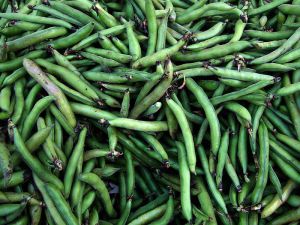
I am having trouble getting these people I live with to appreciate fava beans. What on earth is their problem? For me, favas have a prodigious quality; they fill me with wonder. This family of mine and a few good friends, seem to think I am a bit screwy.
I plant fava seeds in September, maybe October. The summer crops are finished and pulled out to the compost pile, the winter garden is planted. Most of it is meant to be eaten through the winter; chard, kale, parsley, broccoli, onions and more. But, I fill in wherever possible with fava seeds. They germinate, sprout in the fall then are sort of dormant in the winter as we eat all those cruciferous veggies (my family complains some here also). Then, in the very beginning of spring the fava plants wake up and take off for the sky - easily hitting a height taller than me. Many people plant them as “cover crops”; they are nitrogen-fixing plants and renew the soil, nourish the compost. For this purpose they are plowed them under or composted this time of year. But I wait. Wait until those pods are hugely pregnant with beans. Then some random day in May I recruit helpers to haul out the plants and find all the pods (they are by then about 9 in long and swollen with about 6-8 beans). We then take the pods into the house and begin shucking them, forming more compost and a surprisingly small pile of beans. These beans are next briefly dipped into boiling water to blanch them and loosen their skins. After diving them into an ice bath I start shucking each bean out of its whitish covering. “I” because by then I have usually lost all my helpers who somehow do not see the beauty of this process.
Then with my shockingly small pile of bright green beans, I can cook dinner. I usually get two meals out of a harvest. My favorite two recipes are a ragout with sausage, favas, tomatoes and papardelle and, mashed favas and mint as a bed for 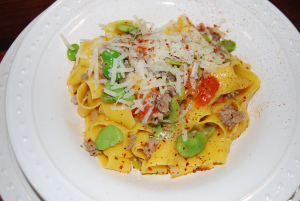 halibut. Both yummy indeed but, both more delightful for the celebration of the passage of the seasons and the miracle of growth. Eating them creates a zen-like experience. It becomes one of those times when you pause, breathe in and really taste the food on your tongue.
Briefly though, there is a danger to eating Favas. People with the X-linked recessive hereditary disease Glucose-6-phosphate dehydrogenase deficiency can develop a fatal hemolytic anemia after eating favas. People of African, Middle Eastern and South Asian descent are affected most often. It could therefore be surprising to hear that favas are most commonly enjoyed in theses very parts of the world. The theory behind this is that the condition of “favism” offers a protection against infection against malaria.
Slow, nourishing, dangerous and tasty… How could you not be awed by these beans? Indeed, it seems one other person around here “gets” them. For mother’s day I was given a poem:
Dear Mom,
You are as exciting as radishes, as pretty as flower.
You are as spicy as peppers and you always have thyme to help me.
You are worth the work like fava beans and as sweet as blackberries.
Worth the work? Me? Hmmm.